
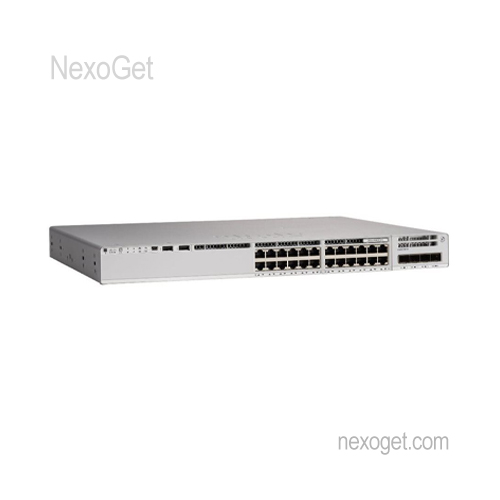
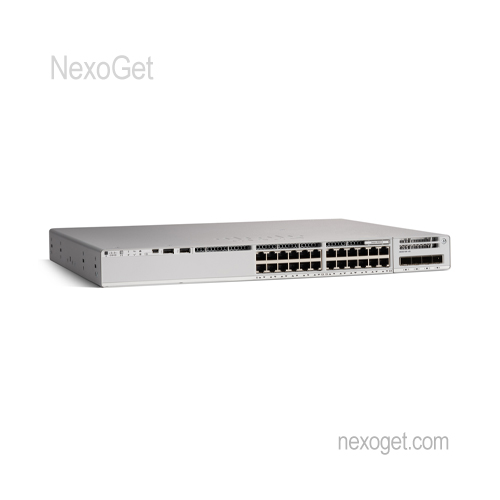
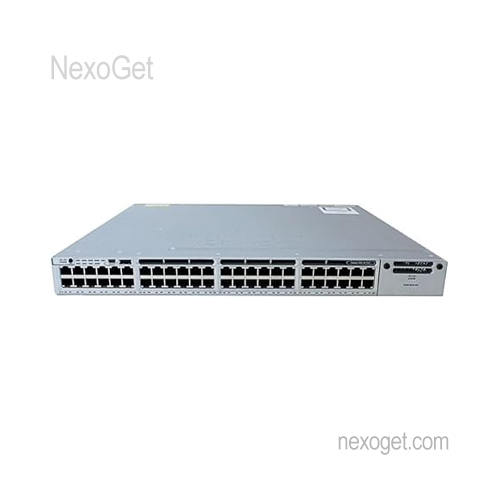
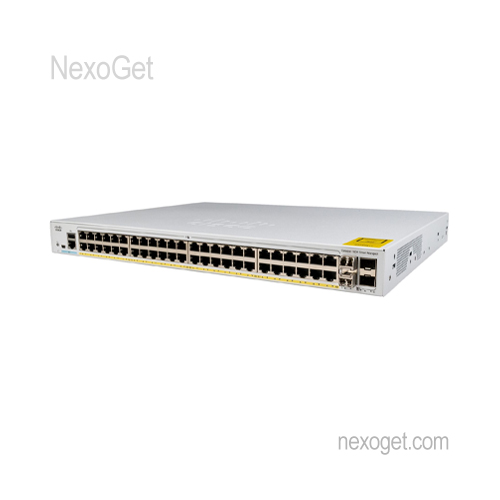
The Cisco WS-C3850-48P-S is a rack-mountable, managed network switch from the Cisco Catalyst 3850 series. It is designed for enterprise, campus, or large-office networks that need a reliable backbone with many PoE-capable ports and flexible configuration options. Cisco+2Router-Switch.com+2
⚙️ Key Technical Specifications
Ports: 48 × Gigabit Ethernet (10/100/1000 Mbps) RJ-45 ports — all with PoE+ support
PoE Power Budget: 435 W total (enough to supply 30 W per port if distributed) in default configuration
Switching Capacity: 176 Gbps total switching bandwidth
Forwarding Performance: ~130.95 Mpps (million packets per second) under optimal conditions
Stacking (scalability): Supports stacking up to 9 switches via StackWise-480, with stack bandwidth up to 480 Gbps — letting multiple physical switches behave as one logical switch.
Management & Software: Fully managed—supports standard management methods (CLI, SNMP, SSH, etc.), VLANs, QoS, Layer 3 routing (with the built-in “IP Base” feature set), ACLs, multicast, IPv4/IPv6, and advanced network services
Uplink / Expansion: Modular uplink support — you can install SFP/SFP+ uplink modules (e.g. for fiber or higher-speed links) for connecting to other network segments or core switches
factor: 1U rack-mountable chassis — standard for server/network racks
🎯 What it’s Good For
The WS-C3850-48P-S is ideal when you need:
A large number of Ethernet ports (48) with PoE support — great for powering devices like IP phones, access-points, security cameras, PoE-enabled IoT devices, etc.
Scalability — thanks to stacking, you can expand your network easily by adding more identical switches and manage them as a single unit.
Enterprise-grade performance and flexibility — support for Layer 2 and Layer 3 features, routing, VLANs, QoS, security and access controls, uplinks, modularity.
Stable backbone in a medium-to-large network — e.g. corporate office floor, campus, data-center edge, or a larger shared workspace with many networked devices.
✅ Strengths — What This Switch Excels At
High port density (48 ports) with PoE+ — helpful if you have many powered devices.
Strong performance (176 Gbps switching capacity, ~131 Mpps forwarding).
Modular uplinks — flexibility to adapt to fiber or high-speed uplink needs.
Scalable via stacking — manage multiple switches as one, great for growing networks.
Rich feature set — robust management, routing, security, VLANs, QoS, IPv6, multicast, and more.
⚠️ Considerations / What to Check Before Use
PoE budget (435 W) means if many ports require maximum power simultaneously, you must ensure the total does not exceed budget — may limit how many devices can get full PoE.
For maximum uplink/throughput or heavy network backbone roles, you may need proper uplink modules (SFP/SFP+) — these are optional, not always included.
As an enterprise-grade switch, configuration and management are more complex than a simple “plug-and-play” unmanaged switch — requires network-management knowledge.
sepehr.yr133 –
is nice